|
|||||||||||||






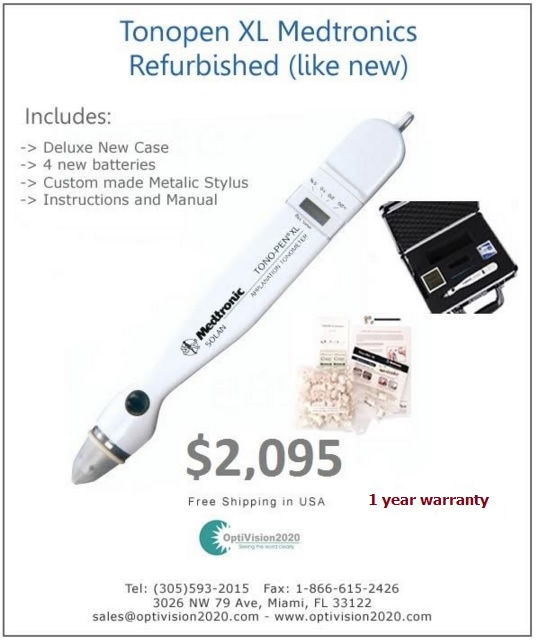
Refurbished Tonopen XL
Click to Zoom!
Visual Acuity Test
(Please scroll down for our products)
The Visual Acuity Test represents the smallest size that can be reliably identified. Visual acuity (VA) is one of many visual perception (eye-based sensory) abilities and is defined as the behavioral ability to resolve fine image details. VA is a quantitative measure of the ability to identify black symbols on a white background at a standardized distance as the size of the symbols is varied. The Visual Acuity Test represents the smallest size that can be reliably identified. VA is the most common clincal measurement of visual function.
Visual acuity test is often measured according to the
size of letters viewed on a Snellen chart or the size of other symbols,
such as Landolt Cs or Tumbling E.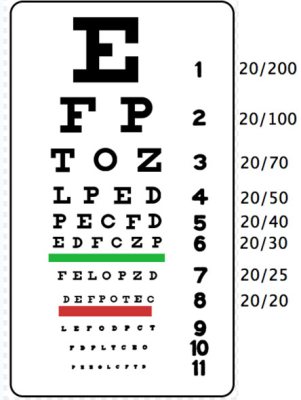
In some countries, acuity is expressed as a vulgar fraction, and in some as a decimal number.
Using the foot as a unit of measurement, (fractional) visual acuity is expressed relative to 20/20. Otherwise, using the metre, visual acuity is expressed relative to 6/6. For all intents and purposes, 6/6 vision is equivalent to 20/20. In the decimal system, the acuity is defined as the reciprocal value of the size of the gap (measured in arc minutes) of the smallest Landolt C that can be reliably identified. A value of 1.0 is equal to 20/20.
If a visual acuity test measures 20/20 is frequently described as meaning that a person can see detail from 20 feet away the same as a person with normal eyesight would see from the same distance. If a person has a visual acuity of 20/40, that person is said to see detail from 20 feet away the same as a person with normal eyesight would see it from 40 feet away. It is possible to have vision superior to 20/20: the maximum acuity of the human eye without visual aids (such as binoculars) is generally thought to be around 20/10 (6/3).
Recent developments in optometry have resulted in corrective lenses conferring upon the wearer a vision of up to 20/10. Some birds, such as hawks are believed to have an acuity of around 20/2, which is significantly better than human eyesight.
Visual Acuity Tests |
||
$15 |
Chronister Pocket Acuity Eye Test Card $29 |
$20 |
|
|
|
Are you done with the Visual Acuity Test ? Go to Home Page

Click here for our Used Equipment Special Sale!
 |
We
accept all major credit cards  |
Phone: (305) 781 3117
Optivision2020, Inc. and Integral Medical Solutions Inc
9808 NW 80th AVE
Unit 10 - J
Hialeah Gardens FL. 33016